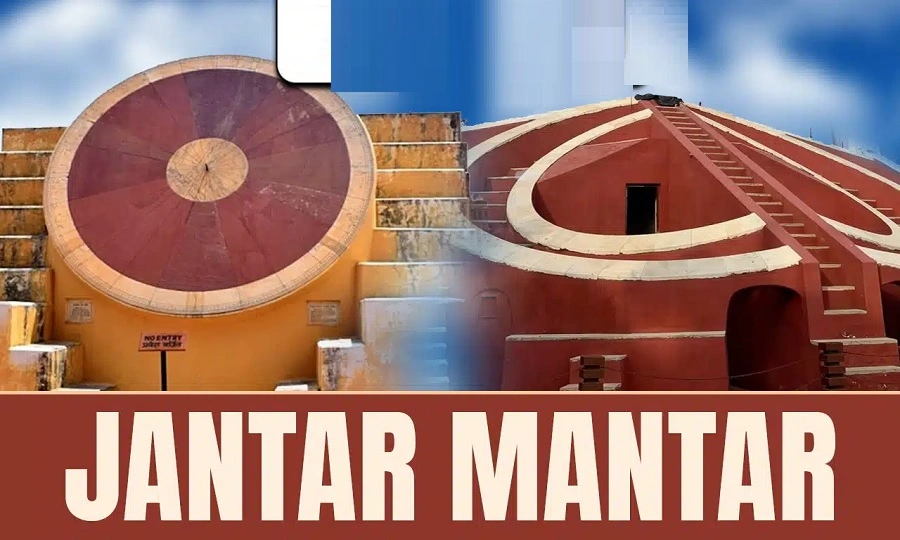

Jantar Mantar
Jantar Mantar is certainly one of India’s finest scientific and architectural achievements. Built throughout the 18th century through the use of Maharaja Sawai Jai Singh II, those amazing observatories had been designed to accurately examine celestial bodies, degree time, assume eclipses, and calculate planetary positions using massive stone gadgets.
Even in 2026, Jantar Mantar remains an essential ancient attraction for college kids, astronomers, researchers, and tourists. Unlike contemporary-day telescopes, those observatories carry out astronomical calculations without electricity or digital generation, showcasing the excellent expertise of Indian astronomy.
Today, the Jaipur Jantar Mantar, a UNESCO World Heritage Site, attracts heaps and thousands of traffic every 12 months, while the Delhi observatory remains one of the capital’s maximum visited historical monuments.
Table of Contents
Summary Table
| Feature | Details |
|---|---|
| Name | Jantar Mantar |
| Built By | Maharaja Sawai Jai Singh II |
| Construction Period | 1724–1735 |
| Purpose | Astronomical observations and calculations |
| Total Observatories Built | 5 |
| Existing Locations | Delhi, Jaipur, Ujjain, Varanasi, Mathura (mostly destroyed) |
| UNESCO Site | Jaipur Jantar Mantar (since 2010) |
| Most Famous Instrument | Samrat Yantra |
| Best Time to Visit | October to March |
| Famous For | Astronomy, architecture, heritage tourism |
What is Jantar Mantar?
Jantar Mantar is a set of big astronomical gadgets produced from stone and masonry for looking at celestial moves.
The phrase “Jantar” comes from the Sanskrit word Yantra, which means device, at the same time as “Mantar” is derived from Mantra, which means calculation or system. Together, the name refers to gadgets used for astronomical calculations.
These observatories were created more advanced than laptop structures and modern-day telescopes. Scientists and astronomers used them to:
- Measure community time
- Track planetary moves
- Observe stars
- Calculate eclipses
- Determine zodiac positions
- Study seasonal adjustments
Their first-rate accuracy continues to impress scientists these days.
History of Jantar Mantar
The statistics of Jantar Mantar started off with Maharaja Sawai Jai Singh II, the founding father of Jaipur and a passionate student of mathematics and astronomy.
During the early 1700s, Jai Singh positioned inaccuracies inside the astronomical tables getting used across India. To decorate observations, he commissioned a sequence of massive observatories built with stone in choice to steel units, which often produced less accurate readings.
Between 1724 and 1735, he mounted 5 observatories at some stage in northern India.
| Observatory | Year | Current Status |
|---|---|---|
| Delhi | 1724 | Well preserved |
| Jaipur | 1728–1734 | UNESCO World Heritage Site |
| Ujjain | 1725 | Operational heritage site |
| Varanasi | 1737 | Preserved |
| Mathura | 1723 | Mostly destroyed |
Each observatory was strategically placed to enhance astronomical observations during precise geographical regions.
Why Was Jantar Mantar Built?
The primary motive of Jantar Mantar became scientific declaration.
Its desires covered:
- Accurate time size
- Preparing astronomical calendars
- Predicting eclipses
- Determining planetary positions
- Calculating solstices and equinoxes
- Supporting astrology with unique astronomical information
At the time, those observatories represented a number of the area’s maximum superior scientific infrastructure.
Architecture of Jantar Mantar
One of the most charming additives of Jantar Mantar is its structure.
Instead of the usage of movable steel devices, the observatories feature massive regular geometric systems made from:
- Stone
- Marble
- Brick
- Lime plaster
Each shape emerges as designed everyday with mathematical thoughts, allowing quite correct measurements of celestial devices.
The devices are aligned with Earth’s axis, making precise observations for the duration of the 12 months.
Major Instruments at Jantar Mantar
1. Samrat Yantra
The Samrat Yantra is the arena’s biggest stone sundial.
Features
- Measures nearby time
- Height of about 27 meters (Jaipur)
- Accuracy of approximately two seconds
- Tracks the Sun’s movement
It remains the most well-known device at Jantar Mantar.
2. Jai Prakash Yantra
This device consists of hemispherical systems representing the celestial sphere.
It enables astronomers:
- Locate stars
- Observe planetary positions
- Understand celestial coordinates
3. Ram Yantra
The Ram Yantra measures:
- Altitude
- Azimuth
- Position of celestial our our bodies
Its spherical layout allows quite correct observations.
4. Misra Yantra
This precise tool combines several astronomical gadgets into one.
It emerge as with the aid of and massive used to:
- Determine the shortest and longest days
- Measure noon
- Compare close by instances
5. Chakra Yantra
The Chakra Yantra measures the declination of celestial bodies and enables calculation of astronomical coordinates.
Jantar Mantar Observatories in India
| City | Highlights |
|---|---|
| Jaipur | Largest observatory, UNESCO World Heritage Site |
| Delhi | First observatory built by Jai Singh II |
| Ujjain | Located near the historical prime meridian of India |
| Varanasi | Smaller but historically important |
| Mathura | Largely destroyed during later periods |
Among them, Jaipur Jantar Mantar is the largest and most fantastic preserved.
Scientific Importance of Jantar Mantar
Although constructed almost three hundred years within the past, Jantar Mantar demonstrates high-quality clinical sophistication.
Its significance includes:
- Advanced astronomical calculations
- High observational accuracy
- Innovative architectural engineering
- Application of mathematics in astronomy
- Historical contribution to Indian technology
Researchers preserve studying the ones devices to recognize historical clinical strategies.
Jantar Mantar as a UNESCO World Heritage Site
In 2010, Jaipur Jantar Mantar acquired UNESCO World Heritage status.
The recognition became furnished due to its:
- Outstanding scientific fee
- Unique architectural format
- Historical importance
- Exceptional preservation
- Contribution to worldwide astronomical background
This honor has improved international interest inside the observatory.
Visiting Jantar Mantar in 2026
If you must visit Jantar Mantar, here are some useful facts.
| Information | Details |
|---|---|
| Opening Time | 9:00 AM |
| Closing Time | 5:00 PM |
| Closed On | Open all days (subject to government notifications) |
| Ideal Visit Duration | 1–2 hours |
| Best Season | October to March |
| Photography | Allowed for personal use |
Visitors are encouraged to hire a guide or use an audio guide to better understand the devices.
Ticket Prices (2026)
Ticket prices may additionally alternate periodically, but visitors can commonly assume:
| Category | Approximate Fee |
|---|---|
| Indian Adults | ₹50–₹100 |
| Foreign Tourists | ₹200–₹300 |
| Students | Discount available with valid ID |
| Children | As per ASI guidelines |
Always verify the stylish fee tag charges earlier than your go to.
Interesting Facts About Jantar Mantar
Here are a few fascinating facts:
- The Samrat Yantra can measure time with an accuracy of about seconds.
- The Jaipur observatory includes 19 most important astronomical devices.
- All gadgets function without electricity.
- The observatories have been designed for the usage of superior mathematical calculations.
- Jai Singh II studied astronomy from Indian, Persian, and European sources in advance rather than building them.
- The structures hold to function underneath easy climate conditions.
- The observatories exhibit one of the greatest examples of clinical shape in India.
Why is Jantar Mantar Still Relevant Today?
Even with current telescopes and satellite generation, Jantar Mantar remains relevant as it showcases how clinical declarations have grown to be accomplished centuries inside the past through the use of geometry and engineering by myself.
It serves as:
- A background monument
- An academic aid
- A picture of India’s scientific legacy
- A studies vacation spot
- An important traveller appeal
Schools, universities, and researchers often put together instructional visits to higher recognize traditional astronomy.
Travel Tips for Visitors
To make the maximum of your go to:
- Visit early in the morning for nice weather.
- Carry water, sunscreen, and a hat at some point of the summer season.
- Hire a licensed guide to apprehend the gadgets.
- Wear snug footwear, as walking is needed.
- Combine your ride with close by attractions like City Palace and Hawa Mahal (Jaipur) or Connaught Place (Delhi).
- Respect monument recommendations and avoid mountain climbing on the devices.
Conclusion
Jantar Mantar stands as a brilliant fusion of technology, arithmetic, shape, and records. Built almost three centuries in the beyond with the resource of Maharaja Sawai Jai Singh II, those observatories maintain to amaze internet site on line visitors with their precision and current layout.
Whether you’re obsessed with astronomy, interested in India’s clinical historic past, or really exploring historic landmarks, Jantar Mantar offers a completely specific and educational revel in. Its large stone devices display that human hobby and clinical questioning have deep roots in Indian civilization.
A trip to Jantar Mantar isn’t always only a journey through statistics, it is a possibility to witness one of the worldwide high-quality examples of ancient astronomical engineering.
Please view more than FAQs
1. What is Jantar Mantar famous for?
Jantar Mantar is famous for its huge astronomical devices because it should be diploma time, have a look at celestial bodies, and carry out astronomical calculations with our current generation.
2. Who constructed Jantar Mantar?
Jantar Mantar was built with the aid of Maharaja Sawai Jai Singh II between 1724 and 1735 to decorate astronomical observations and calendar calculations.
3. Which Jantar Mantar is a UNESCO World Heritage Site?
The Jantar Mantar in Jaipur is identified as a UNESCO World Heritage Site because of its superb medical and architectural significance.
4. How many Jantar Mantars were built in India?
Five Jantar Mantar observatories have been constructed in Delhi, Jaipur, Ujjain, Varanasi, and Mathura, despite the fact that the Mathura observatory now does not survive in its particular form.
5. What is the most essential tool at Jantar Mantar?
The Samrat Yantra is considered the maximum vital tool. It is the arena’s biggest stone sundial and may degree nearby time with first rate accuracy under suitable situations.